Foldable Mini Books


As most all teachers do over the summer, I have been tinkering with student materials (when I should be catching up with missed doctors’ appointments and bathroom cleaning and dog hair vacuuming– or even enjoying a day at the pool). I want a student-made dictionary style resource for commonly misspelled words for my students next year. Ideally, the spelling notes will be in some kind of individual booklet that each student could add to all year. I may have found a solution– a sturdy little mini foldable booklet.

foldable mini book

I called in my temp help to see if the mini books would work, and team RoomMom has been printing, cutting, folding, and testing all day.

mini books materials

Materials

  • 8 1/2″ x 11″ white cardstock OR 4×6 notecards
  • scissors
  • rubberband (medium sized)
  • paper cutter with ruler guidelines

Directions

  • If you are using an 8 1/2″ x 11″ piece of cardstock, cut it in half horizontally and vertically, so you have 4 pieces of cardstock that are 4 1/4″ x 5 1/2″. Fold each piece of cardstock in half the “hamburger” way making sure the corners line up neatly. That means the 5 1/2″ side would be folded. Press down firmly along the fold.

mini books divide paper

  • If you are using notecards, fold 2+ notecards in half the “hamburger” way making sure the corners line up neatly. That means the 6″ side would be folded. Press down firmly along the fold.

spelling mini books folded

  • Once each card is folded, stack the cards on top of each other lining them up evenly. I think 3-4 cards is about the right amount for each booklet. You can use a combination of notecards and cardstock. ** Make sure your sizes match if you are mixing cardstock and notecards.
  • Following the center fold, cut a 1/2″ notch from the top and bottom edge of the stack of cards.

mini books cut knotch

  • Wrap a rubberband around the stack of cards. Have the rubberband sit down into the cut sections of paper to act as the mini book binding. If the rubberband is too tight and pulling on the paper, cut your notches a little deeper.

mini books rubberband

  • Decorate the cover and add notes, drawings, information, doodles… to each page of the booklet.

mini books sampleUses

  • I set up a template in Word and inserted the spelling information I needed. I printed front and back, cut down the paper, and folded the pieces into the booklet. There is space for students to add additional notes, but they will each have a starter booklet.

spelling mini books notes

  • Mr. Star Wars wrote a personal narrative about our trip to North Carolina last summer. Using the Word document template, we inserted pictures and printed the pages (it takes a little spatial thinking to get your pictures on the pages in the order you want when you assemble the booklet). He handwrote the story using the printed pictures as enhancement. This would be a great back to school activity. Students could use a blank booklet and write and illustrate a story about something they did over the summer. You could also use the booklet as a way to assess summer reading by having students create a book review in a mini book.foldable mini book
  • Miss Priss used her booklet to report facts about elephants. This was an end of year project for her. She took her researched information, grouped it by topic, and wrote bulleted facts on each page.

mini book elephantThe spelling mini book template with pre-printed notes for 31 tricky words like there, their, and they’re is now available in my Commonly Misspelled Words product at my teacher store. CLICK HERE to purchase.

Mother’s Day Writing

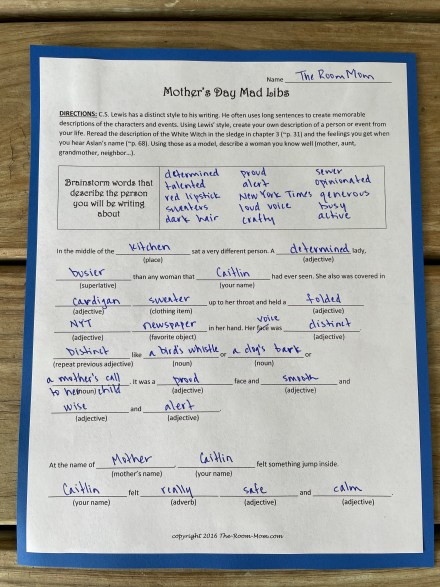
My students just completed a beautiful and meaningful Mother’s Day writing activity. We recently finished reading The Lion, the Witch, and the Wardrobe and spent some time discussing C.S. Lewis’ descriptive sentences. I wanted my students to mimic Lewis’ style in a writing assignment, but I needed a vehicle to make their word choice meaningful. I pulled two passages out of the book and removed key words. I replaced the key words with a blank line and labelled the space with the type of word or part of speech that should go in the blank. Basically, I built a literary Mad Lib.

mothers-day-writing-activity

The students spent some time thinking about their mothers (or another loved one) and brainstormed words to describe that person. Following the brainstorming, they re-read the original passages in The Lion, the Witch, and the Wardrobe and then plugged words into the frame I gave them to create their own beautiful description with a C.S. Lewis vibe.

mothers-day-writing-activity

We typed the paragraphs, and students added small images that corresponded to details in the descriptive writing. We printed the text and pictures on a piece of cardstock and cut them apart. The students folded a small pocket folder using colored cardstock and decorated the cover. The pictures and small paragraph were no bigger than 3″ x 3″ each and fit nicely in the small pocket card.mothers-day-writing-activityNot all of my students are quite finished with this project, but the ones I have read so far make me tear up because they capture such sweet thoughts about a loved one. If you need a thoughtful card or gift for a mother, father, grandparent, sibling… pull a favorite passage from a story and use the basic structure to write a special message.

Mother’s Day Pocket Card Materials

  • 8 3/4″ x 7 1/4″ colored cardstock
  • 4″ x 3 1/2″ white cardstock (optional)

mini pocket folder

Mother’s Day Pocket Card Directions

  • Place the colored cardstock on a flat surface in the landscape direction.
  • Fold the bottom edge (8 3/4″ edge) up about 2″, match the corners carefully, and press firmly to fold the crease.
  • Open the flap and fold the paper in half, so the two 7 1/4″ edges meet. Match the corners carefully and press firmly to fold the crease.
  • Open the paper flat and fold the 2″ section up creating the pocket. The pocket sides will be open but create a little “shelf” to hold the small pieces of paper. Fold the paper in half down the center fold.
  • If you would like, glue the 4″ x 3 1/2″ white rectangle to the front of the folder as a cover for writing a title or salutation.

Want to try your own literary Mad Lib? Click Author Mad Libs to download a free copy of my activity page. To purchase other Lion, the Witch, and the Wardrobe activities, CLICK HERE.

Parent Help

cell project complete

Mr. Star Wars just completed a science cell project– at home. While he could have completed the entire project on his own, this is one of those projects that a parent is probably going to have to offer help in some way. In our case, I drove to the grocery store to buy supplies and helped with formatting his written explanations on the computer. How much help is too much? As a teacher, if I send a multi-day 3-D project home like this, I know parents will be involved. The key is to provide only enough support that you do not “compromise the integrity” of the student project.

cell project close up

Parent Dos

  • Read through the project assignment sheet and directions with your child.
  • Brainstorm a list of supplies and tentative “plan” for completing the project with your child (what to complete each day, so you finish by the deadline). This is a conversation that can happen at the dinner table or in the car on the way home from school.
  • Source supplies (make a trip to the grocery store, Michael’s crafts, hardware store, your pantry/junk closet at home).
  • Reread the directions with your student when the project is finished to make sure the student has completed all of the requirements.

Parent Don’ts

  • Write anything.
  • Rewrite anything.
  • Build anything while a child stands to the side and watches.

Good Project Supplies

If you have class projects come home more than twice a year, I would recommend investing in some common project supplies and saving a few items that can be hard to get when you need it at the last minute. I love having these items on hand at the 11th hour!

  • shoeboxes
  • paper cutter
  • cardstock– assorted colors (Astrobrights are great!)
  • Avery labels– small and large size
  • one set of Sharpie markers in bright colors

cell project

Explorer Timelines

Timelines are a great way for students to get an overview of a history topic. We recently finished a unit in our history book about early explorers. Our textbook organizes the explorers by country, so students read about Marco Polo (Italy) first. Then, move over to Portugal, followed by lots of Spanish guys, and end with England, France, and the Netherlands. The format of the book makes it seem like Spain did all of this conquering alone. Then other people sailed across the Atlantic and explored the northeast coast of North America and Canada last.

explorer timelines group

I had my students create an explorer timeline. With the timelines, we could see that after Marco Polo’s great journey, the explorers of the Americas were actually all sailing and conquering at about the same time. We used paper Sentence Strips for the timelines because they are a great length and width. In addition, they already have a straight line printed on them.

Building an Explorer Timeline

  • Gather your information in notes or a chart like this Explorer Timeline Notes page. Identify the first date and the last date that will appear on the timeline. Determine the time span and then add a few years before the first date and after the last date. This will allow some space at the beginning and end of the timeline. With our explorer timeline, the first year was 1295 and the final year was 1609. We needed a span of at least 314 years.
  • The sentence strips are 24″ in length. The next step is to determine the increments of time along the strip. This is the part that can confuse kids. Their first reaction is to list each explorer in order of travel on evenly spaced lines. But, the point of a timeline is to show how close or far apart events happened from each other. After counting, subtracting, dividing, and measuring, we determined that we would make marks every 1.25″ and each mark would equal 10 years. Creating the spacing on the timeline is great measuring and counting practice.

explorer timelines

  • We noted that there was a break in explorer activity from 1295 until 1492. We created a “broken timeline” where we could jump over 100 years, so we would have enough space to fit all of the years we needed.
  • To further emphasize the point that the explorers from various countries were all sailing within the same time, we color coded the explorer information by sponsoring country. The color on the timeline created a great visual and helped students group the information by time as well as by nationality.

explorer dates

  • The final timeline included 12 explorers, the year of the explorer’s main or first voyage, a brief explanation, and a small illustration that represented the explorer.

The finished timelines gave a great overview of all of the explorers we studied. We were able to make generalizations about the explorers as well as incorporate math skills. Students need more practice reading charts, tables, and graphs, so they can draw conclusions about any data presented. When students are reviewing big chunks of information at the end of a unit of study, have them create a chart or table of some kind to help visualize similarities, differences and big ideas.

explorer timelines close

To purchase the full lesson plans for the explorer timelines, visit my TpT store HERE!

Hooking the Reader

topic sentences activity

Writing the first sentence

Starting a writing assignment is the hardest part

Sometimes, the first sentence is the hardest part of writing for me. Most of my students feel the same way. To cope, they revert to the default starter sentence, “This is my story about _____.” Or, if I am lucky, I get the alternate topic sentence, “I am going to tell you about _____.” Both of these options pain me. I am working hard this year to banish bad topic sentences.

Students can write catchy topic sentences if they see lots of examples that grab their attention. Recently, my students researched one aspect of a Native American tribe and wrote an article about their topic. After they researched but before they began drafting their articles, I had the students flip through my magazine collection. To complete the Magazine Hook Sample Activity, the kids looked for 3 feature articles in different magazines and copied the first sentence only.

sample hook sentences from magazinesAfter collecting a big list of first sentences, we shared and discussed. When we compared the topic sentences, we looked at sentence structure and word choice. We made predictions about the content of the article based on the first sentence. We made a chart that listed conventions the writers used that we liked. We also generated a list of things published writers did NOT do. After the students reviewed lots of examples of good starter sentences, they were let loose to write their own topic sentences for their feature articles. The first sentences were not all publisher ready, but students did create sentences with a little sizzle to them.

Here are some of our favorite topic sentences we found in published articles:

  • Suppose—just suppose—that beings from outer space have landed in your community.
  • Golden lion tamarins grow up fast.
  • Not everyone thinks that prosthetists like Carroll are doing the right things when they meddle in the lives of injured animals.
  • A dark-green fringed leaf frog croaks softly as it sits on a tree branch in a wooded area of Brazil.
  • A small, shy cat peers out from its hiding place of dense cover in thorny shrubs in south Texas.
  • Tucked inside a nest made of moss, two young southern flying squirrels cling to each other.
  • These Halloween treats may be sugar free, but they are still super sweet.
  • Wildfires are unpredictable.
  • On a small street in Philadelphia in the 1920s, there was a factory owned by the Fleer family.

Here are a few tips for writing a good hook courtesy of my fourth graders:

  • Use an unusual sentence structure. Try having a prepositional phrase at the beginning of the sentence. Use a really short sentence to gain attention. Mix up the word order, so it does not follow the subject then verb format.
  • Use key vocabulary words related to the topic.
  • Avoid words like very, nice, good
  • Use active verbs in the topic sentence. However, if you are trying the short-sentence-for-effect technique, you might use a linking verb like is, was, or are with an interesting adjective choice.
  • Use poetic devices like alliteration or onomatopoeia.

The finished articles were part of a Native American magazine project. As with sooo many of my projects, the magazine assignment became much bigger than I originally intended. However, when I saw the finished products, I was impressed. The final magazines looked like they came from a real printer.

Native American magazine covers

Native American magazine interior