Book Motivators

the book collection

I hate to use the word trick, but teachers have all kinds of “methods” to get kids started down the path of a lifelong reader. As a parent, I will pull out a few of these teacher strategies at home if needed too. After consulting with some co-teachers, I am posting my favorite ways to get kids to grab that next book. Whether you teach or have kids at home, one of these tips should get somebody interested in a new book. Any other suggestions out there for book motivators?

book rec samples

Book Recommendations

  • I dedicate one classroom bulletin board to student book recommendations. I laminated a closed manila folder and slit the opening at the top to make a pocket. The folder is attached to the bulletin board and is filled with short Book Recommendation Forms. In their free time, students may fill out a form and pin it to the board. I also add recommendations for the books I read. Before the students head to their weekly library time, we check the board and share recommendations. Often, students arrive at the library with a book or author in mind, which makes library time more productive. They are not wandering around aimlessly hoping a book cover will grab them. Having books ideas in your head before heading to any library is very effective (parent hint).

book rec form completed

Read Aloud Wednesdays

  • I borrowed (stole?) this idea from my good friend and co-worker. Every Wednesday, a student gets to read an excerpt from a favorite book during reading class. A) It provides opportunity to read aloud and improve fluency. B) It encourages book discussion because several students may end up reading the same book about the same time. My teacher friend is in the read aloud rotation, so students hear a “professional” reader occasionally too.

Featured Books

  • The same teacher who has Read Aloud Wednesdays also has “featured books” displayed on her class bookshelf. When this 6th grade teacher finds a good read, she sets it on a book stand at the front of the shelf to highlight the book. There are write-on cards nearby that give a quick endorsement of the book. Students can suggest books for the feature book area as well. Her book shelf looks like the staff recommendation table at the library or Barnes and Noble. Sorry– no picture available. She was teaching class when I tried to stop by to document her fab idea.

What Should I Read Next?

  • Students drop book names into a jar on the teacher’s desk (or a parent’s nightstand?). The teacher draws titles from the jar and that is what the teacher will read next. There is something appealing about having input in what a teacher will do. It is like giving a teacher a homework assignment– every student’s dream.

Reading Requirement

  • Set time limits for completing books. Just like reading a book too quickly will decrease reading comprehension, taking too long to complete a book can have the same effect and kill the enjoyment. Currently, I require students to read 300 pages a month. However, a book must be completed in order for the pages to count. If you want to read the 1,000 page Harry Potter, then you are committing to finishing that book by the end of the month. It prevents students from languishing over a book too long and forgetting character information and key plot details. On the other hand, a student could read three 100-page books, which might be more manageable and can keep the pace reasonable for an average 4th grade reader.

Books with a Sequel

  • Two of the novel studies we completed this year have sequel books. If you read an awesome class novel, it takes no prompting at all to get everyone to read the sequel (Parents, try reading a great book that has a sequel with your child and then leave the child to continue the series). After we finished The Lemonade War by Davies and Dying to Meet You by Klise, all but two students lined up for the sequel. Between the school library and my classroom library, we had three copies of the Lemonade Crime and three copies of Over My Dead Body. I put all the names on a wait list and drew out of a hat until all students had read the book sequels. 

tom angleberger letter

Author Letters

  • I have a whole post about this activity, and I also posted free lesson plans in my TeachersPayTeachers store for writing author letters. The activity has many layers because students research contact information for the author (which might be as simple as reading the publisher page of a book). They recall business letter format to prepare the letter, practice writing addresses– you would be surprised how many 4th graders cannot do this and do not know state abbreviations– and (hopefully) use good writing skills. Every time we receive a reply from an author, it boosts interest in that book. In addition, we have had several authors recommend other book titles to us in the letters. The author letters and replies share a bulletin board with the book recommendations.

book rec wall

Cocoa Kit 2.0

interior cocoa kit

A few weeks ago, I shared a cocoa kit my children and I are giving to the teachers this year. Originally, I included some snickerdoodle cookies along with the cocoa fixings. Well, we ate all of the snickerdoodles before I could finish assembling the boxes, so I made a new batch of cookies this weekend. We used one of my mom’s recipes for Christmas Cookies (yes, that is the name– click for the recipe). They are a rolled cookie. We pulled out all of my mini cookie cutters, so the finished product looks like a little bag of animal crackers. They are perfect for the cocoa kits. I am re-posting the assembly instructions below along with new pictures.

After the events on Friday in Connecticut, I definitely want to let my children’s teachers know they are loved!

The Cocoa Mix: Click here for the Cocoa Mix Recipe I used. I put about two servings of cocoa mix in the plastic bag that went into the box. Alternately, you could simply buy pre-made cocoa mix.

cocoa stirrers with peppermint

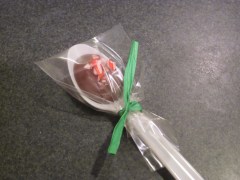
The Chocolate Stirrers: I originally saw these candy spoons on Pinterest. I adapted the idea to make cocoa stirrers. Go to the Cocoa Mix Recipe for directions about how to make the chocolate filling for the spoons. After the chocolate is melted, turn the heat off and let cool slightly (5 min?). While the chocolate cools, rest plastic spoons on the handles of wooden spoons (or another kitchen item) to hold the spoons level. Place a gallon Ziploc bag in a large measuring cup and fold the top of the bag over the edges of the measuring cup. Pour chocolate into the Ziploc. Pull the Ziploc bag out of the measuring cup and hold it like a pastry bag. With scissors, snip off a very tiny piece of one corner and fill spoons with the chocolate. Hold your finger like a stopper over the opening of the bag as you move from spoon to spoon. Sprinkle crushed candy canes on the chocolate and let set.

wrapped cocoa stirrer

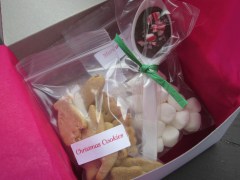
The Other Contents: I added mini marshmallows and about a dozen of the new little cookies. I have a big selection of holiday mini cookie cutters, and my kids cut out their favorite shapes (Christmas trees, mittens, candy canes, angels, Swedish horse…).

christmas cooki animal crackers

The Packaging: I need to buy stock in Avery labels and clear gift bags. I own almost every size possible. I wrapped the bowl of the candy spoon in a 3×4 inch clear bag and tied with raffia ribbon. I used my trusted clear bead bags for the cocoa mix, cookies, and marshmallows and printed small labels for each item. The boxes are Wilton Treat Boxes I purchased at Michael’s.

christmas cookies and cocoa kit

The Gift Tag: I printed a message and directions for making a mug of cocoa on cardstock and tied it to the top of the box. My kids signed their name at the bottom of the tag.

Christmas Cocoa Kit

I donated to the teacher gift fund, so my children’s classroom teachers will be getting a group gift card from the class for the holidays, but I always like to send in a little something extra and personal.

This year’s Christmas teacher sirsee is a Cocoa Kit. I am not sure why I like “kits” so much (in the past year we have given Ice Cream Sundae Kits and Teacher Emergency Kits), but this kit is something the teachers can use at school or share with family at home. I should be able to create an assembly line in my kitchen and pack them up pretty quickly. I am going to make extra to take with us as hostess gifts to holiday parties or to give as gifts to friends and co-workers. What are other festive sirsees to give this holiday season?

The Cocoa Mix: Click here for the Cocoa Mix Recipe I used. I put about two servings of cocoa mix in the plastic bag that went into the box. Alternately, you could simply buy pre-made cocoa mix.

The Chocolate Stirrers: I originally saw these candy spoons on Pinterest. I adapted the idea to make cocoa stirrers. Go to the Cocoa Mix Recipe for directions about how to make the chocolate filling for the spoons. After the chocolate is melted, turn the heat off and let cool slightly (5 min?). While the chocolate cools, rest plastic spoons on the handles of wooden spoons (or another kitchen item) to hold the spoons level. Place a gallon Ziploc bag in a large measuring cup and fold the top of the bag over the edges of the measuring cup. Pour chocolate into the Ziploc. Pull the Ziploc bag out of the measuring cup and hold it like a pastry bag. With scissors, snip off a very tiny piece of one corner and fill spoons with the chocolate. Hold your finger like a stopper over the opening of the bag as you move from spoon to spoon. Sprinkle crushed candy canes on the chocolate and let set.

The Other Contents: I added mini marshmallows and a few cookies to the kit. I used snickerdoodles because I think they are a good dipping cookie for cocoa or coffee. I think gingersnaps or a classic Christmas sugar cookie would work well too.

The Packaging: I need to buy stock in Avery labels and clear gift bags. I own almost every size possible. I wrapped the bowl of the candy spoon in a 3×4 inch clear bag and tied with raffia ribbon. I used my trusted clear bead bags for the cocoa mix, cookies, and marshmallows and printed small labels for each item. The boxes are Wilton Treat Boxes I purchased at Michael’s.

The Gift Tag: I printed a message and directions for making a mug of cocoa on cardstock and tied it to the top of the box. When we are actually getting ready to deliver, I will have my children sign their names on the tag rather than using The Room Mom!

Teacher Speak

A mom friend recently asked me how to contact a “prickly” teacher because of a confusing project grade her daughter received. My mom friend happened to call on my parent teacher conference day, so I was already prepping myself for parent teacher conversations.

There are many lists out there about constructive ways for parents and teachers to communicate. My list below is by no means complete. Since I see both sides, I listed the top three pointers that are most useful to me as a parent and the top three that work well for me as a teacher.

The Parent Side

  1. If you would like a teacher to review a grade, make the question about the paper or grade (de-personalize as much as possible). If you start out your message by saying, “You (teacher) made a mistake,” the teacher will probably feel defensive. Teachers are better at responding to notes that say, “We don’t understand why points were deducted from the conclusion of the essay; could you explain?” Or, “We rechecked question #3 on the test and think it may have been mismarked. Can you look at it again?”
  2. Allow teachers 24 hours to respond to a phone message or e-mail. If you contact a teacher on a Friday afternoon, wait until Monday afternoon before sending another note. After two or three attempts without a response, you might contact the administrator for your child’s class. Try to avoid contacting the administrator without making the teacher aware first. Teachers feel ambushed when that happens.
  3. If you get any comments about material management, using assignment books more effectively, or missing assignments, you may want to focus on organization with your child. Establish routines at home for how, when, and where homework is completed. Keep bookbags and school papers in one place at home and always use that same location. Items won’t get lost or left behind as easily.

The Teacher Side

  1. Keep a Parent Contact Log in your grade book. If you call a parent or speak to a parent in person, note the date and topics discussed. This helps me the teacher be specific when a parent does not remember prior discussions about poor grades or disruptive behavior. If sending an e-mail, save that e-mail (and any replies) to a parent folder for the specific academic year. If it is taking two or three drafts to compose an e-mail, you probably need to just pick up the phone and call.
  2. Do not send home a failing grade on a progress report without contacting a parent first. In fact, if a child is going to fail a whole grading period, the teacher should have been in contact with the parent multiple times and have parent signatures on individual test grades and big assignments.
  3. Always start a conversation with something positive about the student. End the conversation with specific actions for the parents and/or student to keep improving. This is something I learned during student teaching, and it has always stuck with me.

Basically, it all boils down to showing respect. What are other successful strategies you have to avoid miscommunication between the parent and the teacher?

School Stories

In Andrew Clements’ book The School Story, one character says that a school story is “a short novel about kids and stuff that happens mostly at school.” I asked a friend of mine who works in children’s publishing if this type of story really is one of the most popular genres in children’s literature as Clements implies in his book. She said that Clements is an expert at the school story and would know. I get it. These books are typically humorous and easy for children to read because they portray a world that the reader knows well– life at school. Here are a few titles that have received rave reviews from my children, my children’s friends, and my students. What other titles get a gold star?

Chapter Books for Upper Elementary Grades

  • Origami Yoda series by Tom Angleberger
  • Blubber by Judy Blume
  • Because of Mr. Terupt by Rob Buyea
  • Lunch MoneyThe School StoryNo TalkingFrindle, or others by Andrew Clements
  • The Hundred Dresses by Eleanor Estes
  • 7th Level by Jody Feldman
  • Double Dog Dare by Lisa Graff
  • The View from Saturday by E.L. Konigsburg
  • Loser by Jerry Spinelli
  • Hank Zipzer series by Henry Winkler

Chapter Books for Primary Grades

  • Bailey School Kids series by Marcia T. Jones
  • Marty McGuire series by Kate Messner
  • Junie B. Jones series by Barbara Park
  • Jigsaw Jones Mystery series by James Preller

Picture Books

  • Chrysanthemum by Kevin Henkes
  • Miss Nelson series by James Marshall
  • David Goes to School by David Shannon
  • Miss Bindergarten books by Joseph Slate
  • How Do Dinosaurs Go to School? by Tolen and Teague
  • How the Second Grade Got $8205.50 to Visit the Statue of Liberty by Nathan Zimelman