Kindergarten Snack, Again

turkey wrap close

Miss Priss is slowly embracing TheRoomMom version of snack after she realized she wasn’t as hungry in the afternoon on our snack days. She requested turkey wraps for her class this rotation. Not only is it easy to make a basic wrap, but it can be a good school lunch option, and you can fill it with all kinds of meat, cheese, or veggies depending on the tastes of your child. I made extras tonight to take with me to school tomorrow to share with my co-teacher.

turkey wrap ingredients

Ingredients

  • large flour tortillas (I needed 2 packs of 10 tortillas)
  • 1 1/2 to 2 lbs. thinly sliced turkey
  • cream cheese, softened
  • shredded lettuce (optional)
  • grated carrots (optional)

assembling turkey wrap

Directions

  • Spread a thin layer of cream cheese on one side of a tortilla. Cover the entire surface.
  • Cover the cream cheese with a layer of turkey. I use 2-3 slices.
  • Near one edge of the tortilla, sprinkle a line of lettuce and grated carrot.
  • From the end with the lettuce and carrot, roll the tortilla.
  • Slice into 5 pieces. (I discard the ends– and by discard, I mean TheRoomDad eats them.)
  • Can be made the night before and refrigerated since they don’t get soggy!

turkey wraps sliced

For Adults

  • I like to spread the tortilla with Boursin or Alouette cheese and add additional thinly sliced veggies like red pepper.
  • Hummus makes a good spread too instead of the cream cheese.

I am also sending in bags of pretzels because I think this snack may be too “weird” for some kindergarteners. We did make half of the wraps with cream cheese and turkey only, so I am hoping all of the kids might give it a try. What are other good wrap combinations for children or adults?

turkey wraps tupperware

Recipe for a Good Teacher

recipe for a good teacher one card

Teacher Appreciation Week is on the horizon at my daughter’s school, which completely turns my idea brain into overdrive. We are implementing an idea I used during the nursery school years for the kindergarten teachers this year. We are organizing delivery of a week of freezable meals and a grocery store gift card.

E-mail the parents in the class with a list of suggested freezable dishes and ask for volunteers to deliver one item each day of the week. For those who don’t like to cook but want to participate, suggest a $5 donation (per teacher if there is an aide) and use the collection for a grocery store gift card. Finally, send 4×6 blank notecards with directions home via kid mail about 2 weeks before Teacher Appreciation Week. Ask the students to write a “recipe for a good teacher” on the card– or write a note– or draw a picture.

grocery gift card

The Giftcard to Kick Off the Week: Collect donations and purchase a gift card to the local grocery store. You can also pick up one of those hot/cold bags, so the teachers can transport their casseroles home. Deliver the gift card and freezer bag on Monday with a card letting them know that meals are on the way!

sausage artichoke soup

The List: I don’t want the teachers to end up with 5 pans of lasagna, so I send an e-mail to the parent group with days of the week and casserole suggestions. Parents sign up for a day and reply all to the group. Depending on your teachers, you can add bottles of red and white wine too. If your child has 2 teachers, ask that volunteers bring 2 9×9 pans of the same casserole, so both teachers get the same thing. Food should be delivered in disposable containers, so the teachers do not have to return the dish.

  • Tuesday: Italian
  • Wednesday: Soup or Chili (Sausage and Artichoke Soup is an easy freezable soup. Click the name for the recipe.)
  • Thursday: Chicken
  • Friday: Breakfast

recipe for a good teacher card

The Recipe Cards: The concept of a “recipe for a good teacher” is tricky for small children (and some parents). Children do not have to write a recipe. Any thoughtful note or picture will work. Teachers like to be recognized by their students in some way. If students write a recipe, it should list things the teacher does in class that the kids like and then put measurements next to it.

Deliver the recipes on Friday to wrap up Teacher Appreciation Week. In my experience, this gift is the most well received of any that I give. Delivering a freezable meal to any busy friend (not just teachers) is always appreciated.

Ready to Research?


Each year, I approach my 4th grade non-fiction research unit with equal parts excitement and dread. I am excited because along with my students, I always learn something new about an American business founder. I dread the unit because it involves a research paper, and it takes all of my teacher super powers not to jam a child into his locker when he looks up at me and says, “I’ve read EVERYTHING and there is no information about Henry Ford.” Fortunately, I also teach common prefixes, so I can calmly remind the student that REsearch means search again.

research folder for students

Coaching these kids through their first research essay is a good thing, and they acquire so many skills because of it. As much as the process pains me, I repeat it every year. I have used this research system with 4th grade, 6th grade, and 9th grade. It works for every age on any topic in almost every subject area.

Prepping the Research

Before letting kids loose on the Internet to find facts, focus on some sub-topics. In my classroom, students write 3-5 open ended questions they will try to answer. Parents, if you are working with a child at home, brainstorm some sub-topics to give the research a direction.

  • An opened ended question is one that requires multiple sentences to answer. Instead of asking, “When did Ruth Handler sell the first Barbie doll?” ask, “How did Ruth Handler get the idea for a Barbie doll?”
  • Use the 3-5 questions or sub-topics for research. Now, every time a student opens an article, he will be trying to answer one of his questions. Rather than writing random facts, students are actively searching for information that is related to a specific idea about the main topic. In addition, the questions provide key words to help narrow Internet searches and make the research more efficient.
  • The idea is that a student tries to answer all of his questions with one source. Then, the child tries to answer the same questions with a new source. Repeat with a third source. If the child is getting the same information in all 3 sources, it is reliable information. If a student can’t answer any question, he moves on to a fourth source… or a fifth. I have been known to repeat the fact that websites and reference books will not have big red arrows and highlighted words pointing to the exact information someone might need. A student might have to summarize, interpret, and infer reading material. The information will not be provided in the same tidy way as a textbook.

student ben and jerrys research folder

The Research Folder

Create a way for students to contain all of their information, so it does not get lost traveling from school to the locker to home.

  • Give students a manila folder with pockets to hold notecards. Seal business envelopes, cut them in half with a paper cutter, and glue them to the envelope. I also print a short list of Internet reference links and sample bibliography formats, which we glue to the folder as well.
  • Students write each question or sub-topic on one pocket. Any time a student finds a fact related to one question, they write the note on the notecard and store it in the appropriate envelope. Now all related notes are grouped together in a handy carry case.

research folder A notes

Sources and Bibliography

This is very difficult for my students since it is their first serious attempt at a bibliography. Having the pre-printed bibliography page with samples pasted to the manila folder helps.

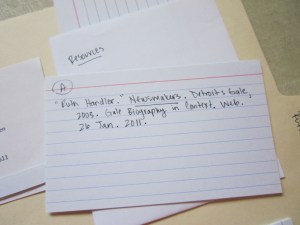
  • As students take notes, they must record the source at the same time. Do not put a source away (or click it closed) without writing the information needed for a bibliography.
  • Code all notecards from one source with some sort of symbol or letter. All “A” cards would relate to one source. Or, all cards with a star would relate to one source.
research folder bibliography

Taking Research Notes

I have to model note taking for my students, and we practice before the project starts. You may not have to go through this step, but it is still a good idea to give some reminders about note taking. I have a few rules I ask the kids to follow.

  • Never write more than one line at a time. This reduces plagiarism since students can’t copy large chunks of text. They must summarize and re-word to fit information into one line at a time.
  • Never write a word on a notecard you do not understand. Look up the unfamiliar word, write a synonym, or explain the word.
  • Avoid Wikipedia if at all possible. Anyone can post information on Wikipedia, so it is not always reliable. Kids like to go there first and then quit. I tell my students that Wikipedia is off limits (audible groans detected immediately).

research folder A notes2

Preparing the Research Paper

If students have sufficient notes, the paper is easy to organize.

  • If students are taking notes related to the questions or sub-topics, notes will be organized and ready to be translated into paragraphs as part of an essay. The organization happens while researching rather than having to sort notecards later and hope that central ideas emerge from the pile of notes.
  • Create an introductory paragraph using the open ended questions or subtopics. Those ideas become the body sentences for the first paragraph.
  • Notes from the first pocket will create the 2nd paragraph that follows the intro and so on.
  • If any extra fun facts are collected, incorporate those into the first or last paragraph.
  • This is a good time to practice or introduce Transition Words. 

research sample paragraphs

My system is by no means foolproof, but it is more efficient than the way I learned to prepare a research paper. To purchase my Non-Fiction Business Unit with the full research paper directions CLICK HERE.

research folder notecards in pocket

Pizza Bread

slice pizza bread

It was our turn again in the kindergarten snack rotation. This time I talked Miss Priss into pizza bread. Our dear neighbor friend has a dear longtime friend who brings a batch of this stuff every time she visits. I love it, and it tastes great at room temperature. I thought it would be a good kindergarten snack that would appeal to all kinds of different eaters (that is code for picky).

If you missed the dill dip post, I will update you about our snack dilemmas. My daughter eats lunch at 10 am and has a snack each day at noon. Since the snack is at normal people lunchtime, I always feel obligated to send in something a little more substantial than a graham cracker when it is our turn to provide snack. My daughter disagrees. She wants me to send in a tiny bag of pretzels like all of the other kids. I don’t want to be like all of the other kids. Disregarding the damage I may be doing to my daughter’s school image, I moved ahead with the pizza bread.

ready dough

Ingredients

  • Ready-Dough*, thawed only– not raised (available in the grocery store freezer section) 
  • turkey pepperoni cut into slivers
  • shredded mozzarella or pizza cheese

* If you can’t locate Ready-Dough, use Pillsbury French Bread in the refrigerated section of the grocery store.

assembling pizza bread

Directions

  • Flatten the thawed Ready-Dough out into a rectangle on a cookie sheet sprayed with Pam. Try to press it out as close to the edges as possible without ripping holes in the dough. If using Pillsbury French Bread, unroll and press out the same way.
  • Sprinkle a generous amount of cheese down the center of the dough. Top with the slivered pepperoni.
  • Fold the sides of the dough into the center like you are folding a business letter. Pinch the ends together.
  • Flip the loaf, so it is seam side down on the cookie sheet and bake according to the package directions for pizza (400 degrees about 15 minutes).
  • Let cool slightly and slice. Serve warm or at room temperature.

folding pizza bread

Notes

  • If you are sending pizza bread to school for snack, make up the loaves, put on cookie sheets, cover with Saran wrap and refrigerate overnight. In the morning, wake up 20 minutes early and put loaves in the oven. Get in the shower while the bread is cooking. Pull out of the oven and let cool. Slice and arrange in a large tupperware. Get as close to room temperature as possible before putting the lid on the tupperware. Send a note to the teachers letting them know to keep snack at room temperature until serving and to NOT refrigerate.
  • If you are taking to a tailgate, follow the school snack serving directions above.
  • If you are taking to a Super Bowl party at a friend’s house, bake the bread at your house, let cool, and wrap completely in tin foil. Re-heat in the tin foil at the friend’s house and serve hot. Set out a dish of marinara sauce for dipping!

pizza bread slices

Book Motivators

the book collection

I hate to use the word trick, but teachers have all kinds of “methods” to get kids started down the path of a lifelong reader. As a parent, I will pull out a few of these teacher strategies at home if needed too. After consulting with some co-teachers, I am posting my favorite ways to get kids to grab that next book. Whether you teach or have kids at home, one of these tips should get somebody interested in a new book. Any other suggestions out there for book motivators?

book rec samples

Book Recommendations

  • I dedicate one classroom bulletin board to student book recommendations. I laminated a closed manila folder and slit the opening at the top to make a pocket. The folder is attached to the bulletin board and is filled with short Book Recommendation Forms. In their free time, students may fill out a form and pin it to the board. I also add recommendations for the books I read. Before the students head to their weekly library time, we check the board and share recommendations. Often, students arrive at the library with a book or author in mind, which makes library time more productive. They are not wandering around aimlessly hoping a book cover will grab them. Having books ideas in your head before heading to any library is very effective (parent hint).

book rec form completed

Read Aloud Wednesdays

  • I borrowed (stole?) this idea from my good friend and co-worker. Every Wednesday, a student gets to read an excerpt from a favorite book during reading class. A) It provides opportunity to read aloud and improve fluency. B) It encourages book discussion because several students may end up reading the same book about the same time. My teacher friend is in the read aloud rotation, so students hear a “professional” reader occasionally too.

Featured Books

  • The same teacher who has Read Aloud Wednesdays also has “featured books” displayed on her class bookshelf. When this 6th grade teacher finds a good read, she sets it on a book stand at the front of the shelf to highlight the book. There are write-on cards nearby that give a quick endorsement of the book. Students can suggest books for the feature book area as well. Her book shelf looks like the staff recommendation table at the library or Barnes and Noble. Sorry– no picture available. She was teaching class when I tried to stop by to document her fab idea.

What Should I Read Next?

  • Students drop book names into a jar on the teacher’s desk (or a parent’s nightstand?). The teacher draws titles from the jar and that is what the teacher will read next. There is something appealing about having input in what a teacher will do. It is like giving a teacher a homework assignment– every student’s dream.

Reading Requirement

  • Set time limits for completing books. Just like reading a book too quickly will decrease reading comprehension, taking too long to complete a book can have the same effect and kill the enjoyment. Currently, I require students to read 300 pages a month. However, a book must be completed in order for the pages to count. If you want to read the 1,000 page Harry Potter, then you are committing to finishing that book by the end of the month. It prevents students from languishing over a book too long and forgetting character information and key plot details. On the other hand, a student could read three 100-page books, which might be more manageable and can keep the pace reasonable for an average 4th grade reader.

Books with a Sequel

  • Two of the novel studies we completed this year have sequel books. If you read an awesome class novel, it takes no prompting at all to get everyone to read the sequel (Parents, try reading a great book that has a sequel with your child and then leave the child to continue the series). After we finished The Lemonade War by Davies and Dying to Meet You by Klise, all but two students lined up for the sequel. Between the school library and my classroom library, we had three copies of the Lemonade Crime and three copies of Over My Dead Body. I put all the names on a wait list and drew out of a hat until all students had read the book sequels. 

tom angleberger letter

Author Letters

  • I have a whole post about this activity, and I also posted free lesson plans in my TeachersPayTeachers store for writing author letters. The activity has many layers because students research contact information for the author (which might be as simple as reading the publisher page of a book). They recall business letter format to prepare the letter, practice writing addresses– you would be surprised how many 4th graders cannot do this and do not know state abbreviations– and (hopefully) use good writing skills. Every time we receive a reply from an author, it boosts interest in that book. In addition, we have had several authors recommend other book titles to us in the letters. The author letters and replies share a bulletin board with the book recommendations.

book rec wall