Writing in a Straight Line on Unlined Paper

writing in straight lines on unlined paper

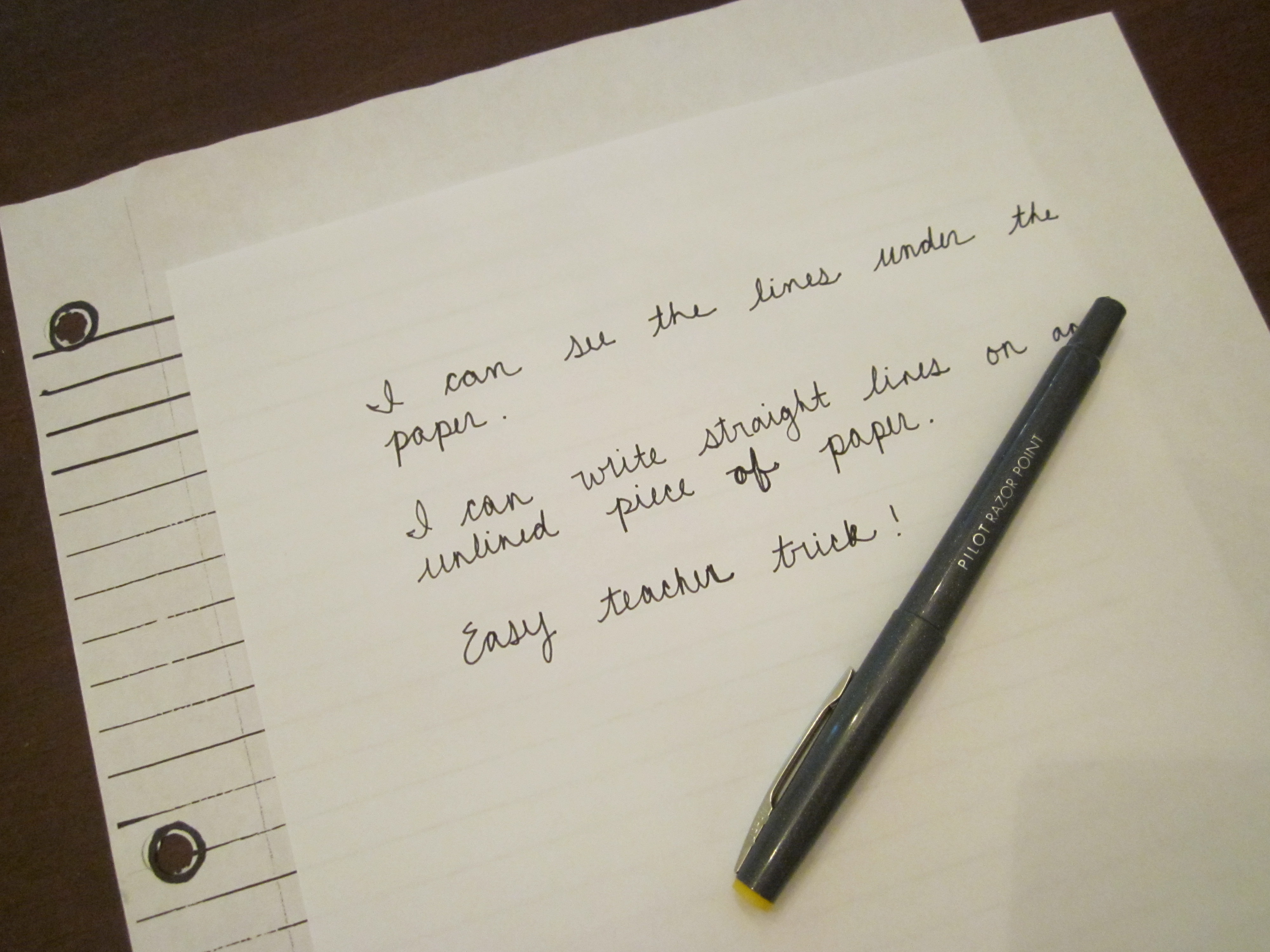
At various times during the year, my students write letters using unlined school stationery. Sometimes we type the letters and run the stationery through the printer for a totally professional product, but sometimes the letters need to be handwritten for a more personal touch. When students try to handwrite lines of text on an unlined piece of paper, the words start to move down the page (or up– or become a random zig zag pattern). By the third line of text, there is no attempt at straight lines any more, and the students are just trying to get all words onto the page before they run out of space.

straight lines paper

I have a simple solution. In order to keep the words straight on the page, I use a trick I learned from the woman who helped me with my wedding invitations. Trace all of the lines on one piece of wide ruled notebook paper with a semi-heavy black marker.

straight lines paper copiesPhotocopy as many pages as you need. When students need to write straight lines on blank paper, place the photocopied lined paper underneath the unlined paper. As you press down to write, the lines are visible, so you have guidelines to keep your writing straight. My students have multiple opportunities to write on unlined paper throughout the year, so I keep the photocopied line pages and reuse them. We have an ongoing Author Letter Project, we write thank you notes to chaperones and hosts after field trips, and we have a project where students create their own letterhead and exchange personal letters with other classes in the school.

straight lines on letterhead

If addressing envelopes, cover the lines on a notecard with black pen and slide the notecard inside the envelope to create guidelines for writing an address neatly and evenly.

straight lines notecard

Sometimes, the envelope paper is thin enough that you do not need to make the notecard lines darker in order to see them through the front of the envelope. Hopefully, you can faintly see the notecard lines in the center of the envelope in the picture below.

straight lines addressing an envelopeThis is one of my favorite teacher hacks that really improve the look of a finished writing assignment without creating too much work for me. And, this tip is not just for students. It is a great trick for anyone needing to write on unlined paper.

Teacher Appreciation Week Gift

teacher appreciation sachet

I am exhausted. The teachers at my school all feel the same way. We pass each other in the hallway with a slight nod and a reference to the remaining time until our summer release. I am not sure why this year I feel more tired than usual, but since it seems to be a common theme, I put together small “restful” gifts for Teacher Appreciation Week. I found directions at MarthaStewart.com for sachets filled with lavender. Apparently, if you place lavender under your pillow while you sleep, it will bring sweet dreams. Sign me up!

The parents’ group at our school organizes daily events for teachers during Teacher Appreciation Week, but I usually like to send an extra thank you to all of the teachers who work with my two children. Since I work at the school my children attend, I know teachers put in additional time with my kids who arrive early and leave late every day. The lavender sachets are meant to be a fancy version of a card. Just a small sirsee to say that we appreciate our teachers.

Materials:

  • 5″ fabric squares with pinked edges (Hobby Lobby sells 24 packs of assorted fabrics)
  • lavender buds (Whole Foods sells small quantities in the spice section, I ordered in bulk from www.thesage.com)
  • funnel (to fill sachet pouches)
  • sewing machine
  • Sachet Gift Tag
  • ribbon

Directions:

  • Sew two fabric squares together with a 1/2″ seam allowance, right sides out. Leave a 1 1/2″ opening.

teacher appreciation sachet fill

  • Poke the funnel into the opening and fill with lavender. I filled with about 1/4 c. of lavender.
  • Sew opening closed.

teacher appreciation sachet tag

  • Print and cut the Sachet Gift Tag labels on white cardstock, add a signature and short note to the tag, and tie to the sachet with coordinating ribbon.

teacher appreciation sachet 2

 For more Teacher Appreciation Week Ideas, visit my Teacher Gifts link in the side bar.

lavender sachets

Spelling Doodle – an Activity with Spelling Words

Along with every other 4th grade student, I want to avoid “write the spelling words 3x each” spelling homework. I am actually not against that kind of homework (especially if the students are writing the spelling words in cursive) since I think it builds a motor memory, but we all get bored with it. One new activity with spelling words I am using is a Spelling Doodle.

spelling doodle word practice

Students use every word on the weekly spelling list to design a word doodle. The challenge is to think of various ways to group the spelling words. Students use a combination of phonics knowledge and word meanings to create word categories. Not only do students practice writing spelling words correctly, they are also activating their knowledge about the ways letters combine to create words, word usage, and definitions of the words.

Give the student a piece of white copy paper and some colored pencils or fun pens. Using all of the spelling words in a list, students create groups of words and label each group with a title. Kids write the words and then add doodles and illustrations to the page to make it colorful and appealing. Talk about the words by sharing the group types. We came up with all kinds of ways to group last week’s words.

An activity with spelling words

What are options for Spelling Doodle groups?

  • Syllable Count (group by how many syllables a word has)
  • Same Root, Prefix, or Suffix (look for common word parts)
  • Same Spelling Pattern in the Beginning, Middle, or End (look for repeated letter groupings, my SPELLING LISTS are created around a spelling pattern or rule, so my students were not allowed to create one giant grouping for all words on the list)
  • Same Starting, Middle, or End Letter Sound
  • Synonyms
  • Antonyms
  • Common Situation (look for a way to group words based on an activity like words you might use at a construction site or while going to a movie– this reminded me of games like Taboo)
  • Common Topic (look for words that have a theme like baking or sports)

I told my students they should try to have 2-4 words per grouping, but if they ran out of options at the end, they could create a group that contained only one word as long as they provided a title. We used colored pencils at school, but I got out the Sharpies when I worked on my samples at home. Definitely add color. If you need an alternative to calling out words when studying for a weekly spelling test, give this spelling activity a try. It works in the classroom and at home.

fun word spelling practice

For more spelling word practice ideas in the classroom or at home, read THIS BLOG POST.

To purchase spelling products based on the most common English spelling rules and patterns, visit my teacher store by CLICKING HERE.

spelling doodle spelling practice activity #spelling #wordwork

Sweet Reads

whizz pop chocolate shopMagical candy is kind of a draw in children’s literature. Mr. Star Wars recently read The Whizz Pop Chocolate Shop and let me borrow it when he finished. In the book, a family inherits a closed down chocolate shop with lots of magical secrets. It is my newest Charlie and the Chocolate Factory “read alike” book. Books that use food (particularly chocolate) as a central plot detail are a big hit with kids.

Mr. Star Wars and I tried to name all of the books we know that use food in some way. We came up with chapter books with candy, chapter books with non-traditional foods– like worms (!), picture books, an even some books that one food item steals a scene. I cut us off after we started on the picture book titles because there are just so many books we could list. What is your favorite book that will make your mouth water?

snicker of magic

Candy (mostly chocolate)

beetles lightly toasted

Gross (but hilarious)

  • Beetles, Lightly Toasted by Phyllis R. Naylor
  • Freckle Juice by Judy Blume
  • How to Eat Fried Worms by Thomas Rockwell

bone soup

Picture Books

Scene Stealer

charlie and the chocolate factory


Poetic Inspiration

concrete poemMy fourth grade students are preparing for the annual Valentine’s Day Poetry Slam showcasing original student prose. I have this fabulous music teacher at my school who enthusiastically embraces this project every year and helps me organize the event. I used to hate to read, teach, discuss, analyze, or create poetry because my memory of studying it as a child is not filled with sunshine and chocolate. My short stint as a high school English teacher did not improve the situation. In fact, many schools handle poetry in such a dry way, we all have a bad taste in our mouth when it comes to poetry.

In the last few years, my view has changed. Poetry can be fun for students and offer a creative way to express feelings students might not share otherwise. I have also started to realize how much poetry enhances other areas of language study.

  • Many poems typically follow a pattern of some kind. There might be a rhyme scheme. Rhyming words reinforce spelling patterns and expand vocabulary. Authors might repeat words or phrases in a specific order to emphasize an idea. Identifying a repetitive word pattern demonstrates a writing style that a student can emulate in their own writing.
  • The repetition of letter sounds draws the attention of the reader to the beginning, middle, or ends of words, which supports spelling instruction. The easiest letter sound repetition to find is alliteration. In the fourth grade, I never teach assonance because I just can not bear using the word with a bunch of ten year olds.
  • Figurative language requires some brain power. A student has to activate background knowledge to interpret expressions that are not literal. When Emily Dickinson tells us that hope is the thing with feathers, students have to translate the thing with feathers to a bird and then compare the bird to hope by tapping into a vocabulary bank for the various meanings and applications of the word, hope. Without critical thinking, the poem’s message would be lost.
  • Poems use words in a creative way. Students often follow the same subject followed by verb sentence order when they write. Poems show how we can have flexibility in our writing.

Poetry can be intimidating for kids, so I started breaking down different poems and types of figures of speech into simple activities to help students create their own poetry.

  • Take a poem you love with many lines that repeat and replace with ideas from your own life. I like to use the first stanza of “Love That Boy” by Walter Dean Myers.  My students keep the beginning of most of the lines and develop their own simile (so I get to teach simile at the same time). My son, Mr. Star Wars, is actually in one of my language arts classes this year and his “Inspired By” poem made me cry. (He does not know I am reprinting his poem here.)

love that teacher poem

  • Give each child an object. I like to choose an object from nature like a cloud, mountain, tree, flower, sunset, or ocean. Have the kids write five sentences about the object, but each sentence must use personification. The cloud could offer comfort. The mountain could glare down at you. The flower could dance. The students list the five sentences to create a poem.

personification activity

  • Provide three categories for students. They could be categories like sports, food, or animals. The students choose a topic like basketball, ice cream, or dog for each category and then generate a word bank to go with the topic. The students go through the word bank and group words that start with the same letter sound. The student also attempt to add words that have the same starting sounds as words that are already in the word bank. Using words with similar sounds to create alliteration, students organize the words into lines of poetry. Voila! Instant poem. (Hint– onomatopoeia words work well with this activity too.)

Many authors have started writing books that center around poetry but are presented in novel(ish) form. They are fast reads and good stories. Here are a few titles that I like.

  • Love That Dog and Hate That Cat by Sharon Creech
  • Gone Fishing by Tamera Wissinger
  • Word After Word After Word by Patricia MacLachlan
  • Emily by Michael Bedard (picture book)

Have some fun writing a short poem this Valentine’s Day!

I have more poetry ideas for the classroom in my teacher store. Click HERE and HERE.