Teacher Tip

sample workbooks

Teachers receive many booklets with reproducible student pages inside. It is easy to recognize this type of teacher material because it looks just like a student workbook but may have 3 holes punched in it. The idea is to have the teacher remove the pages when needed, make copies for students, then start a materials binder that will hold the student worksheet until the teacher needs to copy it again.

Teachers rarely remove the pages because the pages do not pull out easily. The pages tear. The pages get mangled when a person tries to oh-so-carefully remove them along the handy perforation the book publisher provides. Instead, TheRoomMom teachers will push the entire book flat on the copy machine while the copy machine (who think it is smarter than you are) reorients the page, so it copies landscape rather than portrait, and you get a copy of a half a page and a good shot of your arm and watchband.

workbook pages separated

I found a solution. An instructor at a professional development class I attended this summer told me to put the book that you want to separate in the freezer for several hours. When you pull the book out of the freezer, bend the pages back, and the glue will crack. Voila. You can separate all pages and reassemble in a binder.

workbook pages in binder

I apologize to my non-educator followers who might not find today’s post useful. On the other hand, if you have been desperate to find a way to cleanly remove pages from the heavy glue binding in a book, this might just be the tip that will change your world.

cover of workbook in binder

Class Notes

class handbook

Parents receive and/or complete a ton of paperwork from their child’s school the first week or two of school. Most of the materials are distributed in some sort of class orientation with the teacher. A lot of information about math fact tests, spelling test days, and reading requirements is thrown at you in a short amount of time.

As a parent, I jam the papers in a folder near the school directory and do not really look at it again. As a teacher, I am silently fuming when parents ask me repeatedly about my extra help days or my monthly reading due date. Isn’t anyone referring to the FAQ sheet I gave at the beginning of the year, which CLEARLY outlined my policies and procedures? No, they are not because it is sitting in that dusty folder next to the school directory.

This year, I am taking care of the problem. I created a flip chart with all of the information I want parents to have for the school year. I attached magnets to the back, so parents can stick this handbook to the refrigerator. For parents who will not be receiving TheRoomMom’s amazing 4th grade handbook, create your own “Class Cliffs Notes” that you can post in a central location at your house.

Below is my suggested list of helpful class information to have on hand. What other school information do you need throughout the year but forget after the first week of school?

  • Teacher Contact Information– Note the best way to contact the teacher and the amount of time it will take for the teacher to reply. Have the e-mail address and cell phone number (or school phone number) in a place that is easy for you to find. In most cases, it is easiest to contact a teacher by e-mail rather than by phone since we can’t answer the phone during the school day. If you would like to speak with the teacher, send an e-mail listing several times that you are available to have a phone conversation (or conference) to avoid playing phone tag. Let the teacher call you.

class handbook extra help

  • Extra Help Times– Be aware of any weekly extra help the teacher offers. I have a weekly drop-in time every Tuesday after school for 45 minutes. Parents may also e-mail me or send a written note if a student needs one-on-one help. If your child’s teacher provides some form of extra help, know how/when it works.
  • Late Work Policies– If students are sick, make note of how to get make up work and how long a student has to complete make up work. If a student does not do homework or other assignments, ask about any deductions to the final grade or other consequences for incomplete work.
  • Reading Requirement– Most classrooms have a nightly reading requirement that may not show up in the assignment book. Find out if your child is expected to complete work independently each evening that is above and beyond assigned daily work.

class handbook math facts tips

  • Study Tips and General Test Schedule– Many teachers have a weekly test schedule for areas like math fact tests and weekly spelling lessons. For example, my teammate gives math fact tests every Wednesday and Friday. I alternate spelling and vocabulary tests every Thursday. If there is a reliable test schedule, add it to your family calendar. If the teacher gives any study advice, write it down, so your child can study efficiently for these weekly tests. My teammate and I shared math facts study tips and vocabulary study tips in our handbook.

class handbook vocabulary tips

  • Daily Schedule– Know which days students have PE, art, or other classes that may require special clothing. My children need to know PE days, so they will wear sneakers. I like to know which day is art day, so my kids won’t wear the white uniform shirt. If students can have visitors at lunch, note lunch times. If you can actually have the entire weekly schedule for your child posted on the refrigerator, that is helpful for the whole family.

class handbook schedule

I found the flip book idea on Pinterest (of course). First Grade Fairy Tales has the step-by-step directions and template for making the flip book. My new plan is to use the template to make a babysitter/dogsitter flip chart to compile all of the notes that I need to give to our sitters. I want to include emergency contact information, pediatrician names and numbers, basic dog care, and other information I always need to write down for the babysitter. If I finish, I will post some photos.

So That’s How You Spell It

grocery list

This is the grocery list Miss Priss gave me. Can anyone guess what we need from the store?

I always have a student who is a poor speller. There are kids who just never get the hang of the common patterns in the English language. I think our use of text speak and lack of handwriting practice is partly to blame, but I will save that discussion for another post.

I have a few tricks to help my students with common spelling errors, and I give some practice work for the summer too. In the age of spell check, correct spelling will be about recognizing the best way to spell a word rather than having to generate the correct spelling from memory.

If your child needs some practice over the summer or some reminders when school begins again in August, try a few of these spelling tactics. Your son or daughter might not be heading to the National Spelling Bee, but they might catch a few more errors in their writing.

Use What is Already There

  • I often have students misspell words that appear in the test or assignment. Practice looking back through a paper and comparing your spelling to words that are provided in questions or directions or even a word bank.
  • This strategy can also be useful if a child sees a word that rhymes. Rhyming words may have the same spelling pattern and the base part of the word can be copied. If you can spell rock, you might be more likely to spell sock with the CK ending. 
  • The same tactic would work if a child needs to change an ending on a word. If you see the word humid and need to write humidity, a child could make a reasonable guess using the original word given.

copying paragraphs

Practice Copying Words Correctly

  • The more often you spell a word correctly, the more likely you will spell it correctly in the future. There is muscle memory, and your hand memorizes the way letters connect (which is why cursive handwriting is important IMO). Think about writing your name. When I got married, it took awhile to retrain my hand not to automatically begin the letters of my maiden name.
  • If your child’s handwriting is really poor, and you have moved on to keyboarding, you can complete this same activity on the computer, although I think the act of handwriting is more effective.

Practice Adding Endings to Words

  • This is a great reminder about the spelling rules that we are taught directly or pick up through reading. Start with a base word like hop. Add a variety of endings and say aloud why/how the word changes. Hop becomes hopped, hopping, hops. For the ED and ING endings, we doubled the final consonant to protect that vowel sound. For the S ending, we did not need to protect the vowel sound because we were adding the consonant S. In this case, look at the word hoping. How is it pronounced? Why? What is the difference between hopping and hoping.

Practice Locating Mistakes

  • Look at a sentence or small paragraph with errors. Find the errors and make the necessary corrections.

Here are some other 4th grade tips for words that are often confused.

Separate

  • There is A RAT in the middle of the word sepA RATe.

Affect v. Effect

  • Affect is a verb (action– also starts with A). It will often have a helping verb nearby. If you can’t remember your helping verbs, I have a list here in the grammar plan. The storm did AFFECT our electricity.
  • If the word has ED on the end,  it should probably be AFFECT. We were AFFECTED by the power outage. This example also has the helping verb clue.
  • Effect is a noun. It will often have A, AN, or THE nearby and be the subject of the sentence. The EFFECT of the storm was devastating.

Desert v Dessert

  • Desert is a dry place because of little rainfall.
  • Dessert is the yummy treat you have after a meal. It has two S’s because you want two servings!

Their, They’re, or There

  • Their is possessive; it shows ownership. If you can replace their with the word his or her, and the sentence makes sense, use THEIR. We went swimming at their pool. We went swimming at his pool.
  • They’re means they are. Read the sentence with the words they are. If it sounds right, use the contraction. They’re swimming at the neighbor’s pool. They are swimming at the neighbor’s pool. In fact, any time you are dealing with a contraction, use the complete words to check yourself. The replacement word test for their and they’re will work when checking it’s and its. Try using it is and his or her.
  • There is a location. If the replacement words used above sound funny, use THERE. You can also sometimes replace there with at that placeWe will be swimming there. We will be swimming at that place.

Too

  • Too has an extra O because you have more, extra.
  • If you can replace too in a sentence with also or so, you probably need TOO. That soup is too hot, and it burned my tongue. That soup is so hot, and it burned my tongue. I want to eat soup too. I want to eat soup also

I have teaching materials for commonly misspelled words, spelling rules, and spelling patterns. To purchase spelling resources from my TeacherPayTeacher store, CLICK HERE.

Word Trains

Bifocals Word Train bigger

Some of my favorite teaching ideas happen on the fly. My students completed the final lesson in our vocabulary book this week. The vocabulary book is based on Latin roots, common prefixes, and suffixes. Now that it is the end of the year and our “root bank” is full, students have been noticing words all over the place that are combinations of the roots and prefixes we studied all year (Yeah!– something stuck).

So, here is what happened. We studied the root “loc” this week, which is in the word “locomotion”. “Loc” means to move from place to place. A student recalled that we already knew the root “mot” meaning to move or to do. And then the game began.

Have you ever played 6 degrees of Kevin Bacon with movie actors? The Word Train game is the nerdy teacher variation of that game.

  1. You begin with a word that contains 2 known parts like DISORGANIZED (dis and organ).
  2. Connect it with another 2+ part word that shares a root, prefix, or suffix from the original word like ORGANIST (organ and ist).
  3. Add a third word that shares the newly added word part like ACTIVIST (ist and act).
  4. Keep going from there by adding REACT then RECAPTURE then CO-CAPTAIN then COOPERATE then OPERATOR.
  5. To really play like the Kevin Bacon game and test a student’s word knowledge, give them the first word and the last word in the word train and ask them to create the connection. For example, try to get from reheat to illiterate.
Capture Word Train

Click on the picture to view the sample

This was a great vocabulary review, and the students got supercompetitive (super is a prefix from our list, by the way). We have standardized testing coming up, and I am trying to practice reading comprehension and vocabulary skills. This activity forced the students to look at word parts and give definitions based on the parts. It is much more strategic than memorizing definitions.

How many words can you connect? My record is 9. I am sure I could go further if I pulled any word root, not just the ones from my 4th Grade Common Prefix, Root, and Suffix List. Can you beat me? My students did. To download the complete lesson plans for free, click here.

A Word Train

Click on the picture to view the sample

I apologize for the tiny pictures. I kept resizing, and I could not get them to appear larger in the post. If any web experts have advice, please share.

Ready to Research?


Each year, I approach my 4th grade non-fiction research unit with equal parts excitement and dread. I am excited because along with my students, I always learn something new about an American business founder. I dread the unit because it involves a research paper, and it takes all of my teacher super powers not to jam a child into his locker when he looks up at me and says, “I’ve read EVERYTHING and there is no information about Henry Ford.” Fortunately, I also teach common prefixes, so I can calmly remind the student that REsearch means search again.

research folder for students

Coaching these kids through their first research essay is a good thing, and they acquire so many skills because of it. As much as the process pains me, I repeat it every year. I have used this research system with 4th grade, 6th grade, and 9th grade. It works for every age on any topic in almost every subject area.

Prepping the Research

Before letting kids loose on the Internet to find facts, focus on some sub-topics. In my classroom, students write 3-5 open ended questions they will try to answer. Parents, if you are working with a child at home, brainstorm some sub-topics to give the research a direction.

  • An opened ended question is one that requires multiple sentences to answer. Instead of asking, “When did Ruth Handler sell the first Barbie doll?” ask, “How did Ruth Handler get the idea for a Barbie doll?”
  • Use the 3-5 questions or sub-topics for research. Now, every time a student opens an article, he will be trying to answer one of his questions. Rather than writing random facts, students are actively searching for information that is related to a specific idea about the main topic. In addition, the questions provide key words to help narrow Internet searches and make the research more efficient.
  • The idea is that a student tries to answer all of his questions with one source. Then, the child tries to answer the same questions with a new source. Repeat with a third source. If the child is getting the same information in all 3 sources, it is reliable information. If a student can’t answer any question, he moves on to a fourth source… or a fifth. I have been known to repeat the fact that websites and reference books will not have big red arrows and highlighted words pointing to the exact information someone might need. A student might have to summarize, interpret, and infer reading material. The information will not be provided in the same tidy way as a textbook.

student ben and jerrys research folder

The Research Folder

Create a way for students to contain all of their information, so it does not get lost traveling from school to the locker to home.

  • Give students a manila folder with pockets to hold notecards. Seal business envelopes, cut them in half with a paper cutter, and glue them to the envelope. I also print a short list of Internet reference links and sample bibliography formats, which we glue to the folder as well.
  • Students write each question or sub-topic on one pocket. Any time a student finds a fact related to one question, they write the note on the notecard and store it in the appropriate envelope. Now all related notes are grouped together in a handy carry case.

research folder A notes

Sources and Bibliography

This is very difficult for my students since it is their first serious attempt at a bibliography. Having the pre-printed bibliography page with samples pasted to the manila folder helps.

  • As students take notes, they must record the source at the same time. Do not put a source away (or click it closed) without writing the information needed for a bibliography.
  • Code all notecards from one source with some sort of symbol or letter. All “A” cards would relate to one source. Or, all cards with a star would relate to one source.
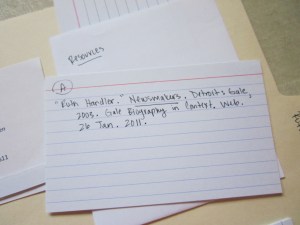
research folder bibliography

Taking Research Notes

I have to model note taking for my students, and we practice before the project starts. You may not have to go through this step, but it is still a good idea to give some reminders about note taking. I have a few rules I ask the kids to follow.

  • Never write more than one line at a time. This reduces plagiarism since students can’t copy large chunks of text. They must summarize and re-word to fit information into one line at a time.
  • Never write a word on a notecard you do not understand. Look up the unfamiliar word, write a synonym, or explain the word.
  • Avoid Wikipedia if at all possible. Anyone can post information on Wikipedia, so it is not always reliable. Kids like to go there first and then quit. I tell my students that Wikipedia is off limits (audible groans detected immediately).

research folder A notes2

Preparing the Research Paper

If students have sufficient notes, the paper is easy to organize.

  • If students are taking notes related to the questions or sub-topics, notes will be organized and ready to be translated into paragraphs as part of an essay. The organization happens while researching rather than having to sort notecards later and hope that central ideas emerge from the pile of notes.
  • Create an introductory paragraph using the open ended questions or subtopics. Those ideas become the body sentences for the first paragraph.
  • Notes from the first pocket will create the 2nd paragraph that follows the intro and so on.
  • If any extra fun facts are collected, incorporate those into the first or last paragraph.
  • This is a good time to practice or introduce Transition Words

research sample paragraphs

My system is by no means foolproof, but it is more efficient than the way I learned to prepare a research paper. To purchase my Non-Fiction Business Unit with the full research paper directions CLICK HERE.

research folder notecards in pocket