Writing in a Straight Line on Unlined Paper

writing in straight lines on unlined paper

At various times during the year, my students write letters using unlined school stationery. Sometimes we type the letters and run the stationery through the printer for a totally professional product, but sometimes the letters need to be handwritten for a more personal touch. When students try to handwrite lines of text on an unlined piece of paper, the words start to move down the page (or up– or become a random zig zag pattern). By the third line of text, there is no attempt at straight lines any more, and the students are just trying to get all words onto the page before they run out of space.

straight lines paper

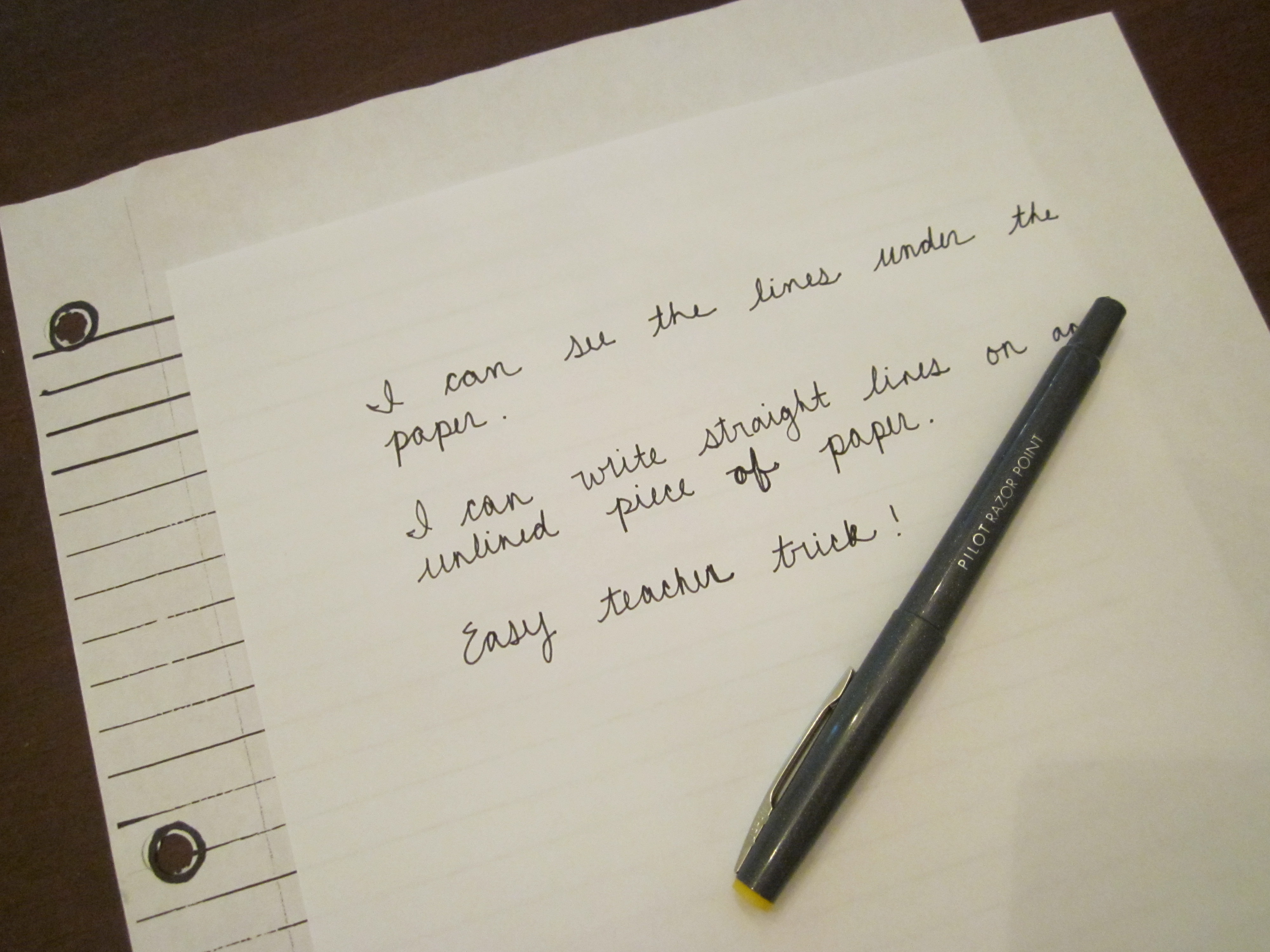
I have a simple solution. In order to keep the words straight on the page, I use a trick I learned from the woman who helped me with my wedding invitations. Trace all of the lines on one piece of wide ruled notebook paper with a semi-heavy black marker.

straight lines paper copiesPhotocopy as many pages as you need. When students need to write straight lines on blank paper, place the photocopied lined paper underneath the unlined paper. As you press down to write, the lines are visible, so you have guidelines to keep your writing straight. My students have multiple opportunities to write on unlined paper throughout the year, so I keep the photocopied line pages and reuse them. We have an ongoing Author Letter Project, we write thank you notes to chaperones and hosts after field trips, and we have a project where students create their own letterhead and exchange personal letters with other classes in the school.

straight lines on letterhead

If addressing envelopes, cover the lines on a notecard with black pen and slide the notecard inside the envelope to create guidelines for writing an address neatly and evenly.

straight lines notecard

Sometimes, the envelope paper is thin enough that you do not need to make the notecard lines darker in order to see them through the front of the envelope. Hopefully, you can faintly see the notecard lines in the center of the envelope in the picture below.

straight lines addressing an envelopeThis is one of my favorite teacher hacks that really improve the look of a finished writing assignment without creating too much work for me. And, this tip is not just for students. It is a great trick for anyone needing to write on unlined paper.

Spelling Doodle – an Activity with Spelling Words

Along with every other 4th grade student, I want to avoid “write the spelling words 3x each” spelling homework. I am actually not against that kind of homework (especially if the students are writing the spelling words in cursive) since I think it builds a motor memory, but we all get bored with it. One new activity with spelling words I am using is a Spelling Doodle.

spelling doodle word practice

Students use every word on the weekly spelling list to design a word doodle. The challenge is to think of various ways to group the spelling words. Students use a combination of phonics knowledge and word meanings to create word categories. Not only do students practice writing spelling words correctly, they are also activating their knowledge about the ways letters combine to create words, word usage, and definitions of the words.

Give the student a piece of white copy paper and some colored pencils or fun pens. Using all of the spelling words in a list, students create groups of words and label each group with a title. Kids write the words and then add doodles and illustrations to the page to make it colorful and appealing. Talk about the words by sharing the group types. We came up with all kinds of ways to group last week’s words.

An activity with spelling words

What are options for Spelling Doodle groups?

  • Syllable Count (group by how many syllables a word has)
  • Same Root, Prefix, or Suffix (look for common word parts)
  • Same Spelling Pattern in the Beginning, Middle, or End (look for repeated letter groupings, my SPELLING LISTS are created around a spelling pattern or rule, so my students were not allowed to create one giant grouping for all words on the list)
  • Same Starting, Middle, or End Letter Sound
  • Synonyms
  • Antonyms
  • Common Situation (look for a way to group words based on an activity like words you might use at a construction site or while going to a movie– this reminded me of games like Taboo)
  • Common Topic (look for words that have a theme like baking or sports)

I told my students they should try to have 2-4 words per grouping, but if they ran out of options at the end, they could create a group that contained only one word as long as they provided a title. We used colored pencils at school, but I got out the Sharpies when I worked on my samples at home. Definitely add color. If you need an alternative to calling out words when studying for a weekly spelling test, give this spelling activity a try. It works in the classroom and at home.

fun word spelling practice

For more spelling word practice ideas in the classroom or at home, read THIS BLOG POST.

To purchase spelling products based on the most common English spelling rules and patterns, visit my teacher store by CLICKING HERE.

spelling doodle spelling practice activity #spelling #wordwork

Test Prep

Testing season for many school districts is upon us. I would venture to say all teachers and parents of school aged children have opinions about student testing. I don’t think the effectiveness of a teacher should be judged by standardized test scores, but I do love to analyze my students’ test scores and compare to the previous year. I calculate averages of the whole group and look for drops and gains. One year, my class average in writing and mechanics improved 14 percentile points. I analyzed the heck out of my daily routine to figure out how to maintain gains like that. Turns out, two sentence corrections per day (DOL to the teachers out there) resulted in big success.

I noticed a drop in something called verbal reasoning. What did I miss in my curriculum during the year that created a dip in the scores? Categorizing words. My students do well with flat out vocabulary because of all of the work we do with roots and prefixes, but when they have to manipulate and compare words in groups, they were not as successful. This year, I spent more time working with word categories, analogies, and sorting words based on a given criteria. It all relates to building a bigger vocabulary and understanding the relationships between words, which creates better readers and writers.

I do not assign last minute test prep work right before testing but build activities into my daily class routine instead. I have several activity ideas that work well for my students.

verbal reasoning sample 1

Idea #1

  • Add a reasoning type question to daily language warm-up activities. I complete two sentence corrections a day, and I added an additional section to my bell ringer activity. The students complete an analogy, choose a good title for a group of words, or complete some other “word work” problem. The students complete the activity in their daily journal (a black and white composition book), and we correct together. The students see the correct answer as soon as they finish their work, and since we have a small amount of practice every day, it does not turn into a cram session. It becomes part of the students’ routine and builds a thinking habit. Click DOL and Verbal Reasoning Bell Ringer Samples to see more.

DOL verbal reasoning

Idea #2

  • Add synonym, analogy, word category, and word relationship questions to weekly vocabulary and spelling tests. Students become familiar with these type of questions and analyze how words fit together on a regular basis rather than seeing it one time during the school year– right before testing.

synonym test sample

Idea #3

  • When completing writing assignments, look for words that are repeated often. Generate word lists in the margins of writing assignments that could replace any repeated words (it’s basically a synonym list or personal thesaurus). When students edit the writing assignment, discuss which words are stronger or weaker. Rank the words in order of importance. Determine why one word might be more appropriate than another. My students just finished writing their American business research essays. The students used the word, business, many times in the essays. We brainstormed a big master list of other words we could utilize (organization, company, group, shop, restaurant, store). We discussed the difference between words like restaurant and store and why one student might use restaurant (the person researching McDonald’s), and one person might use store (the person researching Krispy Kreme). Students should be aware of the connotations different words create.

I compiled some of my verbal reasoning practice questions into a test prep product on TeachersPayTeachers. CLICK HERE to see my Verbal Reasoning Test Prep product.

Poetic Inspiration

concrete poemMy fourth grade students are preparing for the annual Valentine’s Day Poetry Slam showcasing original student prose. I have this fabulous music teacher at my school who enthusiastically embraces this project every year and helps me organize the event. I used to hate to read, teach, discuss, analyze, or create poetry because my memory of studying it as a child is not filled with sunshine and chocolate. My short stint as a high school English teacher did not improve the situation. In fact, many schools handle poetry in such a dry way, we all have a bad taste in our mouth when it comes to poetry.

In the last few years, my view has changed. Poetry can be fun for students and offer a creative way to express feelings students might not share otherwise. I have also started to realize how much poetry enhances other areas of language study.

  • Many poems typically follow a pattern of some kind. There might be a rhyme scheme. Rhyming words reinforce spelling patterns and expand vocabulary. Authors might repeat words or phrases in a specific order to emphasize an idea. Identifying a repetitive word pattern demonstrates a writing style that a student can emulate in their own writing.
  • The repetition of letter sounds draws the attention of the reader to the beginning, middle, or ends of words, which supports spelling instruction. The easiest letter sound repetition to find is alliteration. In the fourth grade, I never teach assonance because I just can not bear using the word with a bunch of ten year olds.
  • Figurative language requires some brain power. A student has to activate background knowledge to interpret expressions that are not literal. When Emily Dickinson tells us that hope is the thing with feathers, students have to translate the thing with feathers to a bird and then compare the bird to hope by tapping into a vocabulary bank for the various meanings and applications of the word, hope. Without critical thinking, the poem’s message would be lost.
  • Poems use words in a creative way. Students often follow the same subject followed by verb sentence order when they write. Poems show how we can have flexibility in our writing.

Poetry can be intimidating for kids, so I started breaking down different poems and types of figures of speech into simple activities to help students create their own poetry.

  • Take a poem you love with many lines that repeat and replace with ideas from your own life. I like to use the first stanza of “Love That Boy” by Walter Dean Myers.  My students keep the beginning of most of the lines and develop their own simile (so I get to teach simile at the same time). My son, Mr. Star Wars, is actually in one of my language arts classes this year and his “Inspired By” poem made me cry. (He does not know I am reprinting his poem here.)

love that teacher poem

  • Give each child an object. I like to choose an object from nature like a cloud, mountain, tree, flower, sunset, or ocean. Have the kids write five sentences about the object, but each sentence must use personification. The cloud could offer comfort. The mountain could glare down at you. The flower could dance. The students list the five sentences to create a poem.

personification activity

  • Provide three categories for students. They could be categories like sports, food, or animals. The students choose a topic like basketball, ice cream, or dog for each category and then generate a word bank to go with the topic. The students go through the word bank and group words that start with the same letter sound. The student also attempt to add words that have the same starting sounds as words that are already in the word bank. Using words with similar sounds to create alliteration, students organize the words into lines of poetry. Voila! Instant poem. (Hint– onomatopoeia words work well with this activity too.)

Many authors have started writing books that center around poetry but are presented in novel(ish) form. They are fast reads and good stories. Here are a few titles that I like.

  • Love That Dog and Hate That Cat by Sharon Creech
  • Gone Fishing by Tamera Wissinger
  • Word After Word After Word by Patricia MacLachlan
  • Emily by Michael Bedard (picture book)

Have some fun writing a short poem this Valentine’s Day!

I have more poetry ideas for the classroom in my teacher store. Click HERE and HERE.

Study Help

study tools

Because I always have parents ask me for study suggestions, I am sharing a list of different ideas to help students prep for a test at home. Students who are just beginning to take tests that involve more than memorized facts need a study buddy (that’s you, parent) to monitor and prod. As much as students would like it to be so, staring at a textbook and notes for 45 minutes without actively doing something with the information on the page does not count as studying.

Around 4th grade, tests are more involved; the thinking to complete the test is more involved, so the prep ahead of time has to be more involved. Learning how to study effectively is a skill that has to be supervised and practiced just like learning a new math skill, mastering a new science concept, or grasping themes in literature.

Locate a Good Study Area

  • Quiet places are preferable, but they should be in proximity of an adult, babysitter, or person who can monitor occasionally. If you have been telling your child “to go study” and sending him off to his room for extended periods of time, I guarantee very little is happening. TV, music, and other electronics should definitely be off and out of view.

electricity flashcards

Start with Memorizing Definitions

  • If an upcoming assessment has multiple vocabulary words that are critical to the key concepts on the test, begin by learning the definitions. There is a memorization component here, so make old fashioned flashcards or use online resources like SpellingCity.com or Memrise.com to create word banks to practice definitions. Once students know basic definitions, they can use the words to explain important concepts. A student might learn a variety of words related to electricity before studying how charges, atoms, and circuits work.

T chart

Set Small, Specific Tasks

  • Telling a student to study without a specific task will not produce results. Know what the student needs to study and give a small, doable task with a time limit. For example, if a student has a test over the Mayans and Aztecs, create a T-chart and write the names of the two groups at the top of the paper. Tell the child to make a list of every fact, detail, idea, they can remember about each culture and bring the list to you after 10 minutes.
  • Give the eager scholar a new job to do after each small increment of time. After a T-chart activity like above, have your student spend another 10 minutes grouping the completed chart by common topics (food, shelter, religion, art, etc.). This is also a good time to identify any big concepts that might be obvious based on grouping facts from the list. Spend a final 10-15 minutes comparing the list to any review sheets from the teacher, reading in the textbook, or other resources from school. After 2-3 specific tasks, rest. Plan to spend shorter amounts of time over several days rather than one massive study session the night before a test.

teacher notes

Think Aloud

  • At the dinner table, in the car, while you make dinner, ask the little learner to explain a process s/he needs to know for the assessment. If you are reviewing for a spelling test, for instance, ask students to explain out loud why a word like hop gets two letter Ps when a suffix is added, and the word becomes hopping. This will be a good litmus test to see if they are only memorizing a process, or if they really know how and why letters work the way they do in words.

spelling study help

Think about the Information in More than One Way

  • When my students are getting ready for vocabulary tests, I always suggest that they use the words in a variety of ways. Yes, they should know the definition and be able to use the word in a sentence, but they should also be able to generate synonyms and antonyms. They should think about situations in real life where the word would appear. They need to be able to recognize the word “in context.” The recall will be much greater if students are developing personal links to the information in different forms. Whenever possible, link the new material to something the student already knows.

vocabulary study help

Create Sample Questions

  • Using any notes or review sheets from class, make up sample problems and practice answering the questions. This works really well for math and grammar tests. As the student answers the practice questions, add in the “think aloud” study suggestion.

prefixes and roots flashcards