That Book Sounds Familiar

charlotte's web    one and only ivan

I teach fourth grade and have elementary school aged children, so I have a legitimate reason for reading children’s books. The truth is– I just like them. They are (usually) fabulous stories; they are fast reads, and it is an activity I can share with my children.

Many of the stories my children and I have been reading lately have a familiar ring to them. Authors are recycling the same plot details and character types from the best books I read growing up. I was so struck by the similarities between Phantom Tollbooth and Peter Nimble and His Fantastic Eyes that I wrote the Peter Nimble author to ask about it. He responded! The Just Deserts section of the book is a small tribute to Jester and his play on words. Jody Feldman credits Dahl as a source of inspiration for her book, The Gollywhopper Games (See the Author Letters post about contacting authors).

Below is a list of some new and old favorites. Is there something on the list that brings back memories of your favorite childhood book? Is there a recent version that is almost as good?

The Classic

The Re-Make

  • Charlotte’s Web by E.B. White
  • The One and Only Ivan by Applegate
  •  Lord of the Rings by Tolkien
  • The Ranger’s Apprentice by Flanagan
  • From the Mixed Up Files of Mrs. Basil E. Frankweiler by Konigsburg
  • Wonderstruck by Selznick
  •  Wrinkle in Time by L’Engle
  • When You Reach Me by Stead
  • Charlie and the Chocolate Factory by Dahl
  • The Gollywhopper Games by Feldman
  • Floors by Carmen
  • Remarkable by Foley
  •  The Phantom Tollbooth by Jester
  • Peter Nimble and His Fantastic Eyes by Auxier
  •  The Boxcar Children Mysteries by Warner
  • The Sherlock Files series by Barrett
  •  Peter Pan by Barrie
  • Peter and the Starcatchers by Barry
  •  Hatchet by Paulsen
  • Far North by Hobbs
  •  Nancy Drew Mysteries by Keene
  • Red Blazer Girls by Beil
  • The Borrowers by Norton
  • Indian in the Cupboard by Banks
  • The Doll People by Martin and Godwin

Book Journals

Last year, the school librarian where I work sent an e-mail to all parents suggesting we start a book journal with our kids. When our librarian’s son was in the first grade, she started recording every book title her son read in a basic black and white composition journal. Her son is now a 9th grader and is still adding to his book journal.

My niece started her book journal when she was in the 4th grade. When I visited last summer, I asked her if she had any new book recommendations for me. She could not think of any suggestions immediately, so she handed me her book journal. I paged through all of the titles dating back 4 years. When I would ask about specific titles, it immediately sparked discussion. Without her yearly lists, she would not have been able to recall nearly as much.

The book journal is a great tool for several reasons. To begin with, it shows how much your reading improves by looking at the book choices from year to year. My son moved from the Jigsaw Jones series (2nd grade range) to Henry Huggins (4th grade range) last year alone.

There is a sense of accomplishment when you see a list of completed books. It is fun to be able to announce that you read 49 books during the school year!

The list prompts memories of books you might have forgotten. It also shows if you followed one author or style of book during a certain period. If you need some new book choices, it is easy to return to the list to help jog your memory for author names or book series. What are other good ways to log book lists?

What To Do: List the grade level at the top of each new page. List the date the book is completed in the left column. List title then author name. In addition, you could add reading level, page count, a rating scale of some kind. Keep it simple so it is not a chore to complete.


School Stories

In Andrew Clements’ book The School Story, one character says that a school story is “a short novel about kids and stuff that happens mostly at school.” I asked a friend of mine who works in children’s publishing if this type of story really is one of the most popular genres in children’s literature as Clements implies in his book. She said that Clements is an expert at the school story and would know. I get it. These books are typically humorous and easy for children to read because they portray a world that the reader knows well– life at school. Here are a few titles that have received rave reviews from my children, my children’s friends, and my students. What other titles get a gold star?

Chapter Books for Upper Elementary Grades

  • Origami Yoda series by Tom Angleberger
  • Blubber by Judy Blume
  • Because of Mr. Terupt by Rob Buyea
  • Lunch MoneyThe School StoryNo TalkingFrindle, or others by Andrew Clements
  • The Hundred Dresses by Eleanor Estes
  • 7th Level by Jody Feldman
  • Double Dog Dare by Lisa Graff
  • The View from Saturday by E.L. Konigsburg
  • Loser by Jerry Spinelli
  • Hank Zipzer series by Henry Winkler

Chapter Books for Primary Grades

  • Bailey School Kids series by Marcia T. Jones
  • Marty McGuire series by Kate Messner
  • Junie B. Jones series by Barbara Park
  • Jigsaw Jones Mystery series by James Preller

Picture Books

  • Chrysanthemum by Kevin Henkes
  • Miss Nelson series by James Marshall
  • David Goes to School by David Shannon
  • Miss Bindergarten books by Joseph Slate
  • How Do Dinosaurs Go to School? by Tolen and Teague
  • How the Second Grade Got $8205.50 to Visit the Statue of Liberty by Nathan Zimelman

Two Gifts in One (Day 7)

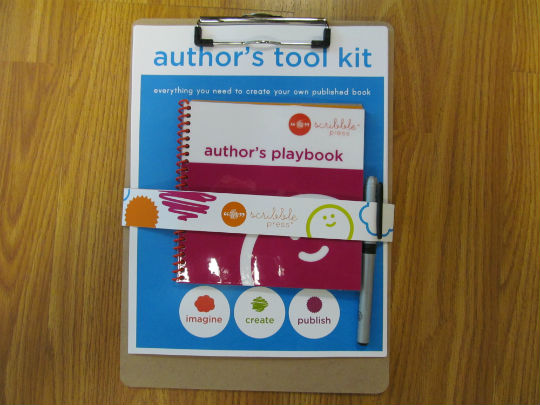
My mom discovered the Scribble Press Store in New York City and picked up an Author’s Tool Kit ($28.95) as a Christmas present for my son a few years back. He LOVES writing stories, and this was an awesome gift idea. It is a design your own book kit. There are a variety of page layouts included in the kit, and the child writes a story and illustrates it. The kit also includes templates for a cover page, dedication page, and an about the author page. Once the pages are completed, you mail them back to Scribble Press, and they professionally bind the book. The book binding fee was included with our gift, but you have the option to order extra copies. Wrap the extra copies and give the finished books as a gift at the next holiday. It is the gift that gives back!

If you happen to live in New York City, you should look at the class and party options at their store. I also noticed an app and online book functions on the website that would be great for teachers (or parents).

School Business

About a week ago, my students started reading The Lemonade War by Jacqueline Davies as a novel study in class. I love teaching this book. Not only do the boys like it as much as the girls, but it is funny and has great practical information about money and starting a business. When the students finish reading the book, about half reach for the sequel, The Lemonade Crime by Davies. If The Lemonade Crime is checked out of the library, there are many other book recommendations (see list below) that portray a main character who gets things going. The characters might run a business, be the leader of a project, or become responsible for something significant.

This type of storyline promotes creativity and an entrepreneurial spirit. Many of these books teach students about the basics of business (profit, loss, partnership, etc.). I also like the fact that these books depict children as problem-solvers without a parent or adult handing them the easy solution. Although, there is usually a supportive adult somewhere in the story. What are your best “independent kid” books? I know I am missing some good ones.

Chapter Books

  • The Bread Winner by Arvella Whitmore
  • Crunch by Leslie Connor
  • The Secret School by Avi
  • Lunch Money by Andrew Clements
  • School Story by Andrew Clements
  • Hotel for Dogs by Lois Duncan
  • Tarantula Shoes by Tom Birdseye
  • Lawn Boy and Lawn Boy Returns by Gary Paulsen
  • Henry and the Paper Route by Beverly Cleary
  • Cosmic by Frank Cottrell Boyce
  • The Baby-Sitters Club series by Ann M. Martin
  • The Toothpaste Millionaire by Jean Merrill

Picture Books

  • A Bargain for Frances by Russell Hoban
  • The Gardener by Sarah Stewart
  • The Lorax by Dr. Seuss
  • Sheep in a Shop by Nancy Shaw
  • Alexander, Who Used To Be Rich Last Sunday by Judith Viorst

Non-Fiction

  • The Day-Glo Brothers by Chris Barton
  • Everyone Wears His Name: A Biography of Levi Strauss by Sondra Henry
  • Model T: How Henry Ford Built a Legend by David Weitzman
  • Chocolate by Hershey: A Story About Milton S. Hershey by Betty Burford
  • Kidpreneurs, Young Entrepeneurs with Big Ideas by Adam Toren and Matthew Toren
  • Growing Money: A Complete Investing Guide for Kids by Gail Karlitz and Debbie Honig